Tutorial with Test Data
In this tutorial, we run crop-row-connector on the test dataset included in the repository and walk through the output it produces.
The Test Dataset
The dataset is found in the test_dataset/ directory at the root of the repository:
test_dataset/input/row_information_global.csv— the detected crop row segments, one per tile.test_dataset/input/points_in_rows.csv— all vegetation points along the rows.test_dataset/orthomosaic_test_data.tif— the orthomosaic the data is derived from (can be viewed with georeferencing tools like QGIS).
A visual representation of all the points in the orthomosaic can be seen below:
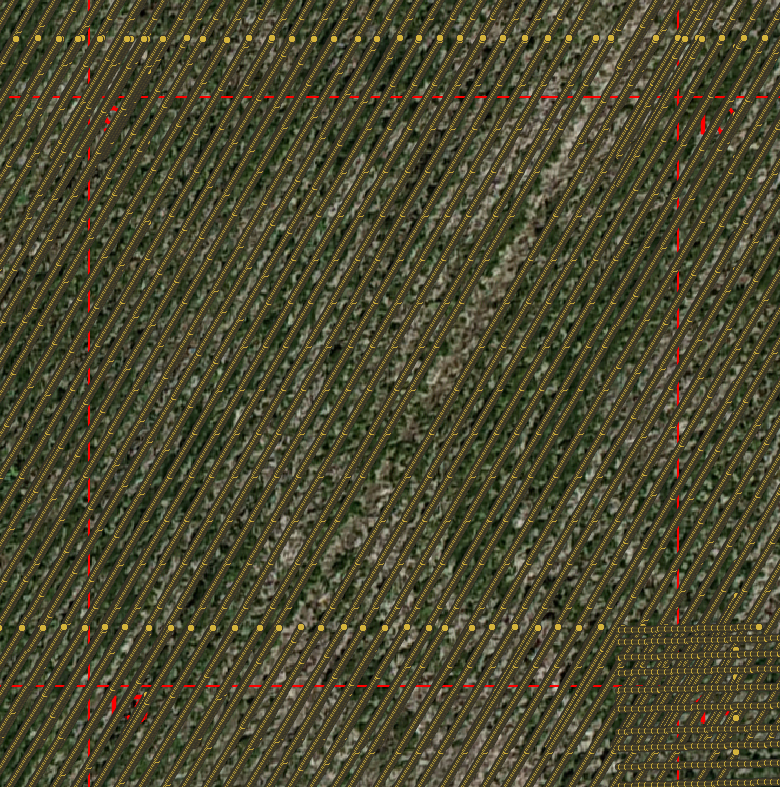
Detected crop rows in an orthomosaic field.
The field contains a rotation: rows in most tiles run at an angle of about 0.52 radians from the X axis, while rows in a few tiles (7, 11, 14 and 15) run at about 1.55 radians — almost perpendicular to the rest. This makes the dataset a good test of the angle tolerance.
Note
All tolerances and lengths are given in the coordinate system of the input data. In the test dataset this is UTM meters.
Running the Connector
If crop-row-connector is not already installed, see installation.
If the installation added crop-row-connector to your PATH, run it as:
crop-row-connector
Otherwise use the module form (note the underscores — module names cannot contain dashes):
python -m crop_row_connector
From here on we assume crop-row-connector is on the PATH; if not, replace crop-row-connector with python -m crop_row_connector in the commands below.
Use the following command to run the connector on the test data:
crop-row-connector \
    test_dataset/input/row_information_global.csv \
    test_dataset/input/points_in_rows.csv \
    --distance_tolerance 0.12 \
    --angle_tolerance 6.9 \
    --output_path_connected_crop_rows test_dataset/output/connected_crop_rows.csv \
    --output_path_vegetation_points test_dataset/output/line_points.csv \
    --output_path_unhealthy_vegetation_segments test_dataset/output/unhealthy \
    --output_path_healthy_vegetation_segments test_dataset/output/healthy
Note
--angle_tolerance is measured in degrees (default: 10). The value 6.9 is used here because of the rotation between tiles in the test field; for a field without rotation the default works well.
All output arguments are optional — any output you do not give a path for is simply not saved.
Understanding the Output
connected_crop_rows.csv — which row segments were connected.
Each row segment appears once, with the connected crop row id it belongs to and up to four neighbours it was linked to:
row_index |
tile |
row |
con_1_tile |
con_1_row |
con_2_tile |
con_2_row |
con_3_tile |
con_3_row |
con_4_tile |
con_4_row |
dubli_error |
|---|---|---|---|---|---|---|---|---|---|---|---|
0 |
0 |
1 |
4 |
4 |
1 |
2 |
False |
||||
0 |
1 |
2 |
0 |
1 |
False |
||||||
1 |
0 |
2 |
1 |
3 |
False |
row_index: id of the connected crop row (all segments of one physical row share this id)
tile, row: the tile and row number this segment came from
con_N_tile, con_N_row: the tile and row numbers of connected segments
dubli_error:
Trueif this segment was assigned to more than one connected crop row, which indicates a problem with the chosen tolerances
line_points.csv — all vegetation points, regrouped by connected crop row:
row |
x |
y |
vegetation |
duplicate |
|---|---|---|---|---|
0 |
497023.84 |
6162180.51 |
33 |
False |
0 |
497023.84 |
6162180.52 |
17 |
False |
0 |
497023.85 |
6162180.53 |
55 |
False |
row: id of the connected crop row (matches
row_indexabove)x, y: point coordinates
vegetation: grayscale vegetation intensity (0–255) at this point
duplicate:
Trueif the point was present in more than one row segment
healthy / unhealthy shapefiles — vegetation health segments as line geometries (healthy.shp and unhealthy.shp plus sidecar files), with a single attribute Crop_row giving the connected crop row id. These can be opened directly in QGIS.
Expected Result
With the command above, the test data connects into 252 crop rows out of 594 detected row segments — the remaining fragments belong to the rotated part of the field, where rows stop at the rotation boundary. If you see around 577 rows instead, your --angle_tolerance is too small (for example if it is accidentally given in radians — remember it is in degrees).
The connected crop rows look like this:
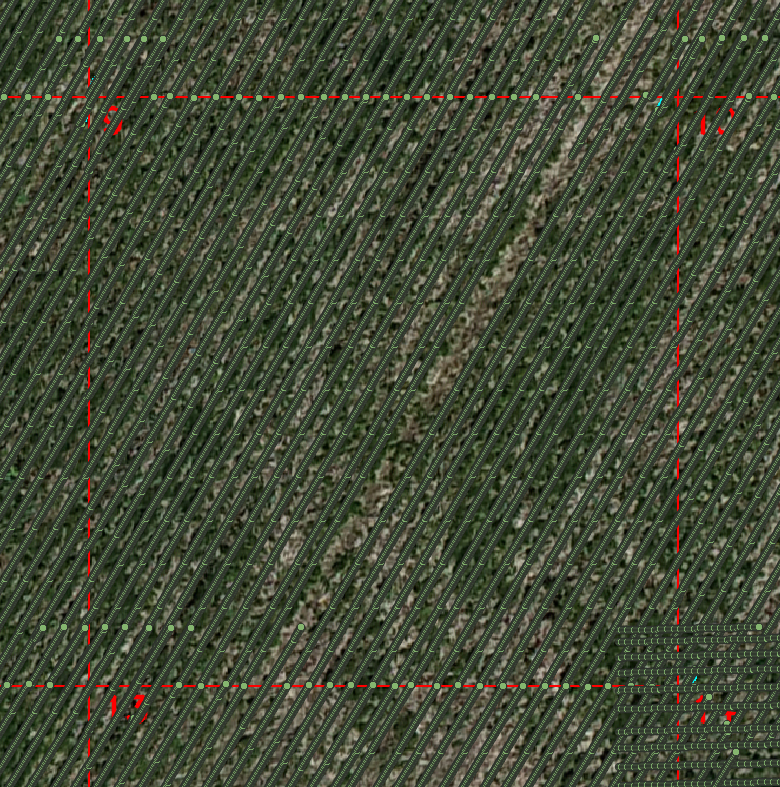
Orthomosaic with the connected crop rows.
A single connected crop row spanning multiple tiles:
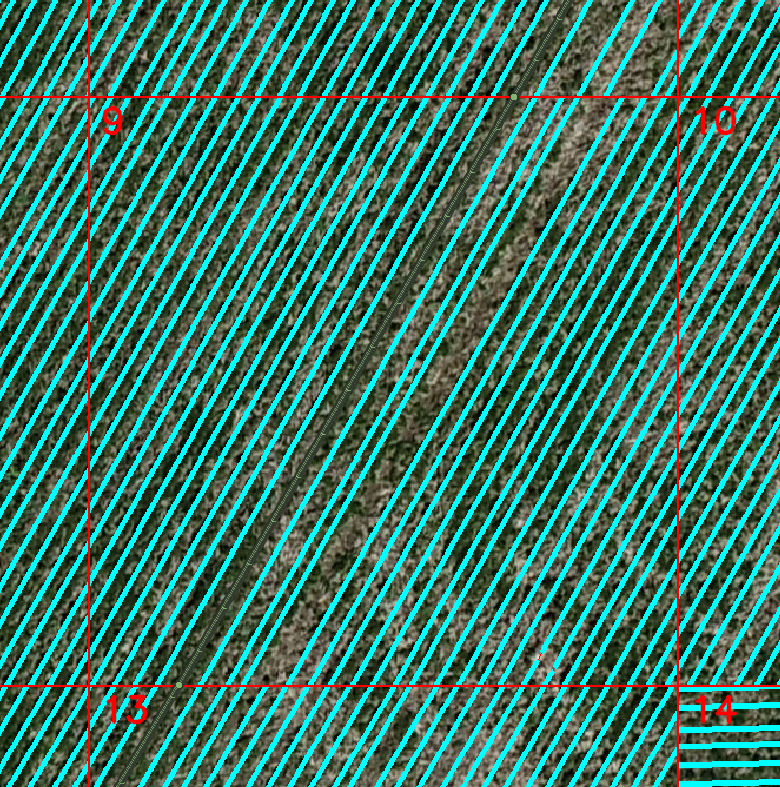
A single connected crop row.